
By Inés Sanguinetti & Carmen Olaechea
ARTS – HEALTH – CONTEXT – RESILIENCE – EVIDENCE – IMPACT – CULTURE
Art constituted itself as an ideal language for the expression and mobilization of desires and emotions, and therefore, it becomes a powerful tool for promoting and repairing health, allowing individuals and communities rework critical, painful or problematic situations and to promote better and happier scenarios for their lives. Bettina Bravo1
What makes this statement doubly interesting is that it was not made by an artist, but by a psychiatrist. And, above all, because it assigns art the power, not only to repair pain and the imbalance that it causes, but also to create conditions to project a happier life. Thus, it presents art as a tool that crosses the arc of health from prevention to healing.
Art, by itself, has its own place as an essential right, a right already recognized in multiple international treaties such as the Universal Declaration of Human Rights; the International Pact on Economic, Social and Cultural Rights; the American Convention on Human Rights with its additional protocol of San Salvador and the Convention on Children’s rights. In turn, all these treaties also recognize health as a fundamental right.
What we want to highlight in this article is that, from both art and health perspective, there are more and more reflections and research in the World aimed not only to show why they are fundamental rights but to also to better understand how there is a virtuous bond between the two in which art becomes a transforming agent collaborating, in various ways, with a state of balance, well-being and good health in individual and community life.
There is a first approach to this bond that manifests itself as a complementary relationship in which art accompanies a possibility or need that arises from health. For example, in 2019 the WHO completed an investigation2 on the beneficial effects of art on health, concluding that the arts facilitate behaviors that promote health since people, who participate in artistic disciplines, are more likely to eat healthy and exercise and that they are more alert to risky situations such as drug use. Or, well known throughout the world, the particular value that the arts provide for communication of health issues because they transmit critical messages in a way that not only encourages better conceptual and emotional understanding of the problem, but also a better appropriation of the healthy mechanisms that are being promoted.

But there is also another way of understanding the link between art and health, a much richer one based not so much on a complementarity way but on the parity and intertwining of the two fields. In order to see this, we need to broaden our understanding of each of the two elements. For health, it is worth making its description more complex as proposed by the WHO since 2009: the state of complete physical, mental, spiritual and social well-being, in harmony with the environment, and that it is only possible to achieve it by acting on its determinants, with actions inter- and transdisciplinary, intersectoral, and with active community participation.3 For the arts, in turn, it is worth first liberating them from the isolated place where they were trapped under the idea of fine arts and the institutions that manage them, and think about them, instead, in relation to creativity, a universal human trait, and its power to generate spaces for the encounter and expression as well as conditions of freedom, understanding and production.
Art opens doors to other ways of accessing the interdependence of life by offering languages and perspectives that help us integrate doing, feeling and thinking. That is why we say art and creativity contribute to individual and collective resilience by stimulating sensitive experience, critical view and creativity and improving communication and cognitive, motor and sensory skills that contribute to the keep and recover well-being and health.
Under these ideas we can define art as the ability to create that all individual has, an experience that connects perception, feeling and thought with the possibility of redefining through color, shape and style, all expressions of the individual who talk about him/her and his/her reality. To see art like this is to understand it as the most beautiful tool that any society has to look at and transform its environment and its daily life, allowing people to dream and recreate a different and better world. Art is the elucubration of the being into which all forms of expression enter and it is the sublimation of the exalted spirit.
And why do we dare to make such strong claims about the power of art? Because we have been working with art for 22 years as a transforming agent of individuals and communities and noting how it encourages, nurtures and accompanies the development of profound transformation processes. During this time we have developed playful and creative methodologies that encourage creativity, engaging understanding and emotions to address complex issues through artistic strategies that bring critical view, integration and joy experiences to the community. And these methodologies have the possibility of intertwining art and creativity with processes and experiences associated with different themes such as democracy, education, coexistence, reconciliation, conflict transformation and healing.
Likewise, in the last 8 years, we have been accompanied by different academic institutions that carried out research with the goal of analyzing how our work with art and creativity is reflected in manifestations of well-being4. Thus we verify that art opens the door to new languages that enrich communication by improving coexistence; makes the link between emotion and cognition visible by improving understanding; gives back to the body the awareness of its integrality, strengthening self-perception and stimulates alternative modes of collective organization that help the community to better integrate.
At Crear Vale La Pena we deeply believe in art as a tool for social transformation, which works on a day-to-day basis, strengthening people’s subjectivity to give meaning to personal and collective life projects. From this perspective creativity and artistic expression can be a motor to promote different forms of resilience in people.
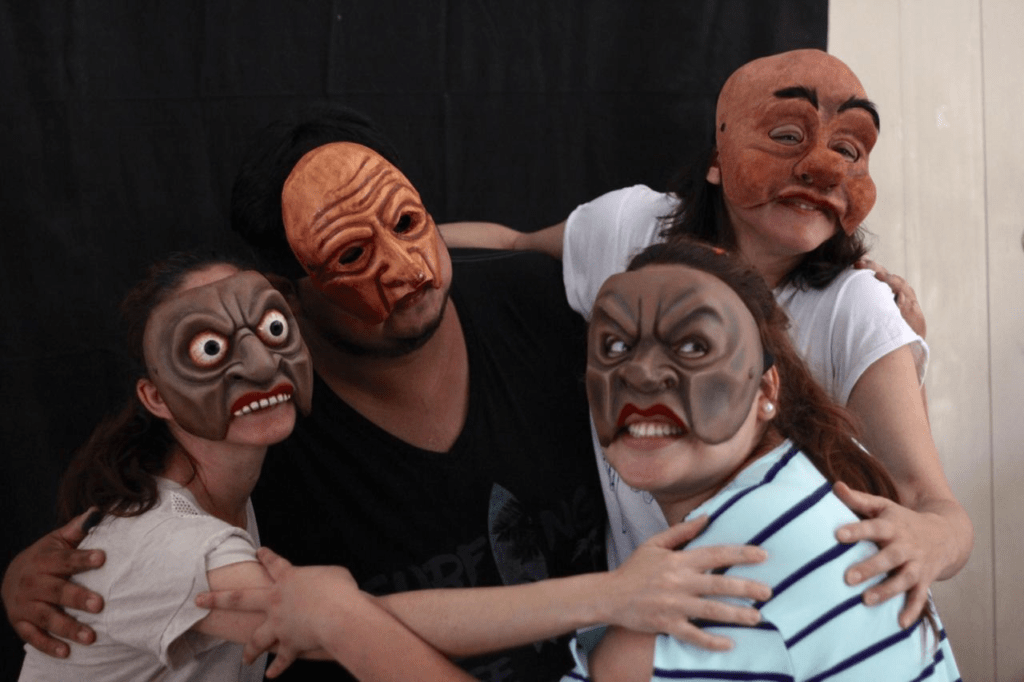
Finally, since 2020, together with this trend in the world to pay more and more attention to the role of art in relation to health, we are now part of an investigation, led by the renowned psychiatrist Stephan Priebe5, which seeks to understand, among other things, the link between art programs and health in young people who are going through processes of mental anguish. This is the international project OLA6, which unites 4 countries (England-Argentina-Colombia and Peru), 4 universities and 4 artistic-cultural organizations that during 5 years, will put artists and specialists in mental health to work together to understand how is the resilience processes in young people living traumatic situations and how art and creative processes promote and nurture this resilience.
Inés Sanguinetti, Co-founder and president of Fundación Crear Vale la Pena. Artistic Director for the Creative Environments Program (Art and Creativity across the curriculum), that has reach more than 60.000 people from 8 cities of Argentina and has been recognised as one of Latin America’s 13 most pedagogic innovative experiences by the BID, the OEA and the OEI. Member of the board at National Arts Fund in Argentina (2016-2020) and International Teaching Arts Collaborative (ITAC). Today, her task in Argentina and Latinamerica is to transfer creativity and wellbeing methodologies applied to improve teaching and learning processes for artists, teachers, social workers and businesses.
Carmen Olaechea, has been working 30 years with the Latin American civil society in developing conceptual and strategic frameworks; designing and implementing collaborative learning architectures; designing, developing and supervising projects and programs; evaluating local and international projects and managing risks. In the last 10 years the main focus of her work has been related to art and social transformation, conflict transformation and sustainability. Carmen is chairwoman of Fundación Cambio Democrático, with focus on dialogue and conflict transformation, international counselor for Crear Vale La Pena, with focus on arts for social transformation and co-responsible for Learning Exchanges in IMPACT: a platform for Art, Culture and Conflict Transformation.
1 Bettina Bravo is medical director of the Therapeutic Community Siempre Habrá Otro Camino (SHOC) in the province of Buenos Aires in Argentina. She is also an advisor to the Art and Prevention of Gender Violence, Maltreatment and Child Sexual Abuse Program of Fundación Crear Vale La Pena. Translated by the authors.
2 Daisy Fancourt, Associate Professor of Psychobiology and Epidemiology at University College of London, who was actively involved in this research, explains: “Art activities are classified as ‘multimodal’ health interventions because they combine multiple psychological, physical, social and behavioral factors with an intrinsic aesthetic motivation when participating”. Researchers Nils Fietje and Daisy Fancourt present the research in: https://cutt.ly/IfCIoLW
3 Declaration of Lima on Art, Health and Development. 2009.
4 For the ABC program and now Creative Environments, there have been three quality investigations, that have been carried out by the University of San Andrés, by the Observatorio de Desarrollo Local Sociedad y Territorio and by Facultad Latinoamericana de Ciencias Sociales de Argentina (FLACSO), respectively.
To see the investigations results please visit: https://cutt.ly/vfCIurt
5 Stefan Priebe: Professor of Social and Community Psychiatry at Queen Mary University in London. Director of the WHO Collaborating Center for the Development of Mental Health Services in the world, and member of the NIHR Global Health Research Group for the Development of Psychosocial Interventions. In addition, he is Director of Research for the Institute of Population Health Sciences at QMUL, and an honorary consultant psychiatrist for the East London NHS Foundation Trust, of which he was also Director of Research for over 20 years.
6 OLA building resilience: Reducing distress in young people”, a research whose main objective is to understand resilience and the development of resources to overcome depression and anxiety in young people in urban areas of Latin America. This research is convened and organized by People’s Palace Projects and Queen Mary University of London. There are also part of this research: Fundación Crea Vale la pena (Argentina); Fundación Batuta (Colombia); Familia Ayara (Colombia) and Teatro La Plaza (Peru).